Who Is the MOTU 828 For? A 28-in/32-out Interface That Ties Your Synths and MPC Together (2026)
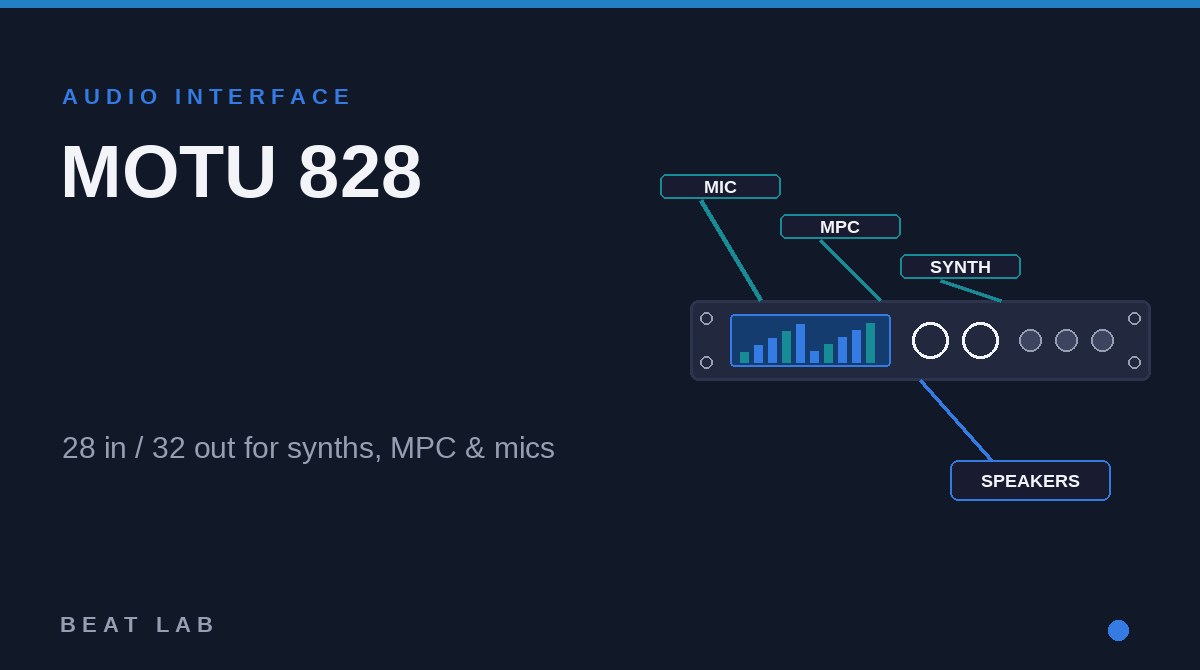
MOTU's "828" is a long-running audio interface series. The 5th-generation model, released in January 2024, arrived as a completely new design. It's defined by large-scale routing capability at 28 in / 32 out, low latency, and a flat resolution delivered by an ESS DAC.
In this article, the Beat Lab editorial team reviewed the official MOTU site (motu.com) as of September 29, 2026, and lays out what's inside the 5th-gen 828, where it fits in a beatmaking setup, and who the roughly ¥200,000 investment is actually right for. If you want to compare it against other options first, see our guide on how to choose an audio interface and four recommendations.
What is the MOTU 828? Key features and basics
According to the company, the new MOTU 828 is a 28-in/32-out USB3 audio interface with a powerful built-in DSP mixer, compatible with Mac, Windows and iOS (USB-C connector, USB 3.2 Gen 1 / 5Gbps, USB2 compatible). As the successor to the 828es, it packs the specs modern beatmaking and home-recording setups want into a space-saving 1U rack.
Main features and specs
- Resolution: Equipped with the "ESS Sabre32™ DAC". The company claims 125dB of dynamic range, letting you monitor down to the nuances of deep sub-bass.
- I/O (28in/32out): 10 analog in / 10 analog out (two combo mic/line/Hi-Z inputs plus eight line inputs; eight line outputs plus two XLR main outputs), plus two banks (16ch) of ADAT optical I/O and S/PDIF. You can keep hardware synths, samplers, outboard compressors and more connected at all times.
- CueMix 5: A built-in DSP mixer (24 in / 8 stereo buses, with reverb, EQ, gate and compressor) that keeps load off your computer. Beyond effect processing, it lets you manage complex routing visually.
▶ Official demo video (MOTU)
Five points from a beatmaking perspective
1. Ten analog inputs remove the need for a large mixer
If you own several hardware synths or MPCs, you previously tended to need a mixer to sum their signals. Because the new 828 has a rich set of rear inputs, you can keep external gear connected directly to it, cutting the space a separate mixer would take. It's a design that suits anyone who wants to simplify the gear around their desk.
2. Space-saving 1U rack mount with a highly legible display
Despite this much I/O, it fits into just 1U of rack space. According to the company, the front panel's 3.9-inch full-color display (480×128 pixels) shows real-time meters for all inputs and outputs. It also functions as the "display" of a permanently installed production setup.
3. "CueMix 5" for remote control from an iPad or phone
The company explains that the CueMix 5 control app can be operated on the computer, and also launched from an iPad or smartphone over the same Wi-Fi network as the computer running the 828. You can control each channel's volume and routing from a tablet at hand, enabling operation close to a digital mixer.
4. Complex routing is easy to build
With its large number of outputs, unconventional routing involving the DAW is easy to set up. For example, you could handle the following flow simultaneously, without swapping patch cables:
- Launch a hardware synth (such as a microKORG) in the DAW
- Send audio from an assigned independent output to an amp for a talkbox
- Capture the sound coming out of the talkbox tube with a mic (input) and record it into the DAW
- Meanwhile, send the track's master to your speakers from a separate main output
The more your workflow relies on rearranging outboard-based setups, the greater the benefit of this flexibility.
5. Low-latency monitoring and built-in effects
Recording latency is given in the official spec as RTL of about 2ms (at 96kHz / 32 samples). In addition, without loading your computer's CPU, you can record while monitoring with reverb, EQ and compression applied by the 828's built-in DSP. The recorded signal itself is described as tending toward a flat character, making it a design well-suited to a plugin-processing workflow downstream.

Specs and price (as of September 29, 2026)
| Item | MOTU 828 (5th gen, released 2024) |
|---|---|
| Total I/O | 28 in / 32 out, 60ch total (at 44.1/48kHz) |
| Analog inputs | XLR/TRS combo (mic/line/Hi-Z) ×2 (+48V, -20dB pad, up to +74dB gain, with send/return insert), TRS line inputs ×8 |
| Analog outputs | TRS line outputs ×8 (DC-coupled), XLR main outputs ×2, headphone outputs ×2 |
| Digital I/O | ADAT optical 2 banks (16ch, S/MUX), S/PDIF (RCA) |
| Computer connection | USB-C (USB 3.2 Gen 1 / 5Gbps, USB2 compatible), class-compliant (Mac/Windows/iOS) |
| Latency | RTL ~2ms (at 96kHz / 32-sample buffer, official figure) |
| DAC / sample rate | ESS Sabre32™ DAC (125dB dynamic range) / up to 192kHz |
| DSP mixer | 24 in / 8 stereo buses, with reverb, 4-band EQ, gate and compressor. Wi-Fi remote control via CueMix 5 |
| Other | 3.9-inch RGB display, MIDI IN/OUT, word clock IN/OUT, footswitch input, talkback, A/B speaker switching, latching power button |
| Bundled software | CueMix 5, MOTU Performer Lite, Ableton Live Lite, 6GB of loop content |
| Size / weight | 1U rack (48.26 × 31.1 × 4.44cm) / approx. 5kg |
| Street price | Around ¥200,000 in Japan (about ¥198,000 incl. tax at major retailers, ¥194,520 on Amazon Japan, as of September 29, 2026) |
*Specs were confirmed by our editorial team on September 29, 2026 from the official MOTU site (motu.com). Prices are tax-included estimates based on same-day research at Japanese retailers (Ikebe, Rock oN, Amazon Japan; Sound House was higher at ¥220,568), and vary with exchange rates and stock.
Two drawbacks to know before buying
1. Overkill for those who work entirely in the box (plugins only)
The market price is around ¥200,000. If you have no external gear, don't plan to add any, and work solely with headphones in a fully in-the-box style, this abundant I/O may go underused. On the other hand, for those who want to raise their studio's audio-quality baseline with a single unit and secure future expandability, it's a strong option.
2. A desktop unit, not suited to being carried around
At 1U rack size and about 5kg, it isn't suited to being carried out with a laptop for casual production on the go. It's a fixed, desktop unit to run within a home production setup.
MOTU 828 online reviews and reputation (summarized)
As of publication, within what our editorial team checked, user reviews broadly express the following sentiments (paraphrased/summarized). Please confirm actual assessments in retailer reviews before purchase.
Positive comments
- Comments to the effect that "the sound is flat with good imaging, and you don't lose track of a synth's air or the tail of a reverb"
- Comments to the effect that "latency stays low even running many channels at once over USB3"
- Comments to the effect that "a setup that was cluttered with mixers and patch bays came together into a single unit thanks to the 828's routing"
Critical comments
- Comments to the effect that "CueMix 5 is so feature-rich that it takes some getting used to before you grasp the routing concept"
- Comments to the effect that "because it's a 1U rack size, placing it directly on a desk takes up a fair amount of space"
Frequently asked questions
Q1. How many I/O does the new MOTU 828 (5th gen) have?
28 in / 32 out (60 channels total) at 44.1/48kHz. This includes two combo mic/line/Hi-Z inputs, eight TRS line inputs, eight TRS line outputs, two XLR main outputs, two banks of ADAT optical (16ch), S/PDIF and two headphone outputs (per official MOTU information as of September 29, 2026).
Q2. Can the MOTU 828 be used with an iPad or iPhone?
Yes. According to the company it is USB audio class-compliant, so it connects to iOS devices without a driver. Furthermore, on the same Wi-Fi network you can remotely control the built-in mixer from an iPad or phone using the CueMix 5 app.
Q3. How low is the latency?
MOTU's official spec states a round-trip latency (RTL) of about 2ms at 96kHz with a 32-sample buffer. In addition, using the built-in DSP mixer you can record while monitoring directly with effects applied, with latency that is essentially imperceptible.
Q4. Does it come with DAW software?
According to the company it includes MOTU Performer Lite and Ableton Live Lite, the CueMix 5 control app, and 6GB of loop content (official information as of September 2026). It also works as-is with major DAWs such as Pro Tools, Logic and Cubase.
Summary: the MOTU 828 is a "hub that integrates your hardware"
The new MOTU 828 condenses ESS conversion, the expandability to integrate external gear in one place, and the convenience of operating like a digital mixer, all into a 1U rack. The roughly ¥200,000 price is by no means cheap, but for beatmakers who want to keep synths and samplers permanently connected and build out a studio, it can be a long-serving "hub," in our editorial team's view. A realistic route is to first check the I/O count your use case needs in our guide to choosing an audio interface, and add the 828 to your shortlist once you've determined you need many I/O.
For the personal angle — the interface history that led our site's owner to the 828 (Mbox 2 mini → US-2000 → 003 Rack → SSL2+ → 828) and the "enough inputs, and it has to fit in a rack" reasoning behind the choice — see the gear interview (hardware edition).